Summary
Thank you for attending my Introduction to Digital Photography course at the CCP. It was a pleasure to help you with your photographic journey and I hope you received a lot from the weekend.
Don’t forget to download your course notes from http://test.leswalkling.com/intro/
Your course notes will be online until 9th October – I’ll then replace them in preparation for my next CCP course – The Digital Lightroom on 10-11 October.
My What sort of a Photographer are you? notes are a check list of all the different image attributes and capture factors that you can incorporate into your photographic practice. I hope they help you to setup and work with your camera in an understood and facilitating way through prioritising those attributes. For example, you might decide that photographing landscapes and cityscapes with a wide angle lens (perspective) and a big F Number (depth of field) on a tripod with long exposure times and a low iSO (high image quality) is really appealing. Or you might decide that ‘street photography’ where fast shutter speeds (stopping motion) and a high ISO settings (photographing in low light levels) while hand-holding (spontaneous) with a telephoto lens (cropping tightly in camera) to capture those fleeting decisive moments in our lives is what interests you the most. And these are just two of the many possibilities in the broadly generous and engrossing world of photography.
Also don’t forget my basic approach to Finding the Image in a Scene:
• Something captures my attention
• Is what captures my attention in the foreground (a figure) or in the background (a ground)?
• If it is a figure, what is behind it, or if it is a ground what is in front of it?
• I then walk forward and backwards observing (camera like) the changing scale of the figure relative to the background.
• Once I am happy with the scale of the figure relative to its background I stop at that spot, and then zoom or change my prime (non zoom) lens to crop the image as desired
• At the same time I remember to observe the diagonals running through the image, and ensure there is something ‘different’ in each quadrant of the composition.
• I next ask myself what is most important in the drawing of this image – depth of field or subject movement?
• I set my f-stop (with Aperture Priority) and/or shutter speed (Shutter Speed Priority) accordingly.
• However if under those lighting conditions I can’t achieve both my desired f-stop (depth of field) AND shutter speed (movement), I then, and only then, increase my ISO rating to achieve my desired f-stop and shutter-speed combination. I also understand the trade-off is the possibility of decreased image quality because of higher noise levels at higher ISO ratings.
• I then take the picture.
In practice this only takes a few moments, but at first you should expect it to take much longer because you are also learning how to do this. And you are also learning how images ‘work’, that is, how they capture our attention and imagination. The more you practice these things, the more intuitive they will become. This is a solid method that once you make it your own through practice and interpretation, it will quickly become an efficient yet sophisticated approach.
My Basic Camera Craft Exercises extends this approach through a range of Capture Factors experiments that will refine your understanding and practice.
There are also three videos on Importing Lightroom, Developing Lightroom and Printing Lightroom. While these are not introductory videos I hope they are nevertheless of some assistance in helping you archive, catalogue, process and print your pictures. Note that the Printing Lightroom video is about printing your pictures from Lightroom to a desktop printer directly connected to your computer. However if you are printing at an external service provider, such as OfficeWorks or Harvey Norman or one of the professional photo labs listed on the last page of your Introduction to Digital Photography Course Notes, then you need to contact that service provider and ask them what they require from you in terms of file size, image format and colour management options. You would then Lightroom/File/Export a new file according to their specifications, which they will print for you.
I also added My Emotional Theory of Print Size notes and Depth of Field Principles notes to our resource page.
And finally never overlook how complicated photography really is because you ‘need to know a little about everything to know anything at all’. Therefore it is important to be patient and forgiving as you work through my notes and exercises and practice and develop your craft. Try to keep your technique simple and straight forward by sticking to the basics, for example, instead of zooming in and out all the time or constantly changing lenses, set your zoom lens to one focal length or stick with just one prime (fixed focal length) lens for a whole week or longer. In this way you start to discover the ‘personality of that lens (or focal length) and even when your camera is not with you, you can still anticipate how the scene in front of you will look as a photograph. Such an approach helps to break down the complexity of our cameras into easily assimilated functions, which over time will combine to provide you with a simple but dependable workflow.
However if you get stuck or have any really pressing questions, please don’t hesitate to contact me. It would be a pleasure to hear from you and know how you are doing.
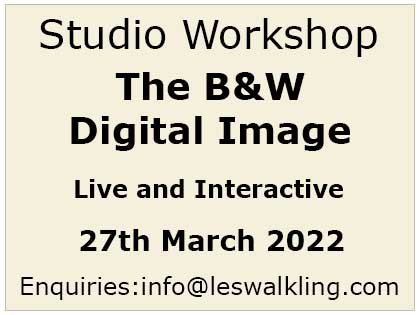
All my contact details are in the footer at the bottom of this email, including my FaceBook business page where I post regular announcements. There is also a Subscribe button if you wish to receive bi-monthly email updates of my events, public lectures, courses and workshops. My next CCP courses are The Digital Lightroom on the 10-11 October (http://test.leswalkling.com/courses/digital-lightroom/), followed by my Lighting and Composition Course on 31 October-01 November ( http://test.leswalkling.com/courses/lighting-composition/). I also run an extensive series of specialised Studio Workshops in my Heidelberg studio that might also be helpful and of interest as your practice grows and consolidates. Details are on my web site at http://test.leswalkling.com/courses/studio-workshops/
All the best.
Les
Les Walkling & Co Pty Ltd
7-9 Avoca Street
Heidelberg VIC 3084
AUSTRALIA
7-9 Avoca Street
Heidelberg VIC 3084
AUSTRALIA
Studio: +613 9459 0093
Les Mobile: +614 3859 0093
Andrey Mobile: +614 3336 2280
info@leswalkling.com
www.leswalkling.com
www.facebook.com/leswalkling
Production and Consulting Services
Courses and Workshops
SUBSCRIBE